Excel workbook
Risk Register and Mitigation Tracker
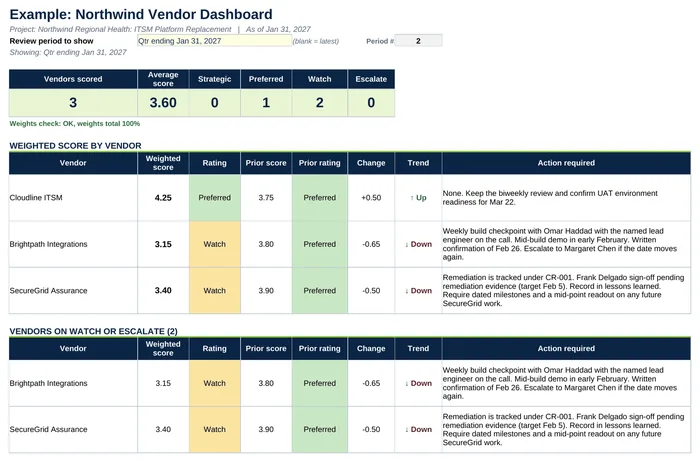
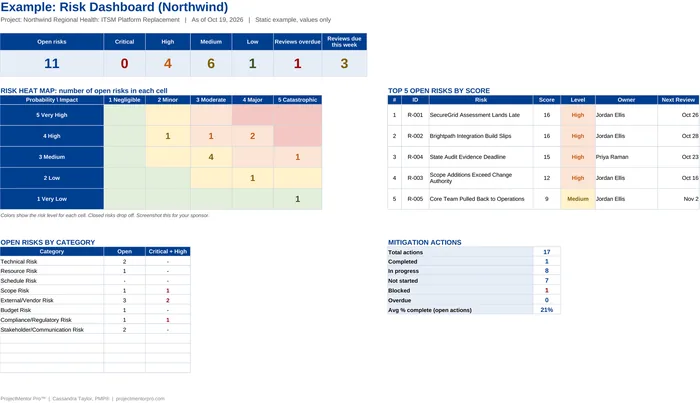
A 100-row risk register, mitigation log, live dashboard with heat map, and a settings tab you can tune to your organization.
Run the project week to week: risks, issues, money, forecasts and vendors.
The Risk Register, the RAID Log and RAID + Actions & Decisions build on each other. This short video shows what each one adds so you can pick the right fit for your project.
Most projects don't fail because nobody saw the problem. They fail because it lived in someone's head.
I'm Cassandra Taylor, and these are three ways to put your project in plain sight. Each one works in Excel or Google Sheets, and each one builds on the last.
Start with the Risk Register. One log, where every risk is scored, owned and dated, with a tracker for each mitigation step.
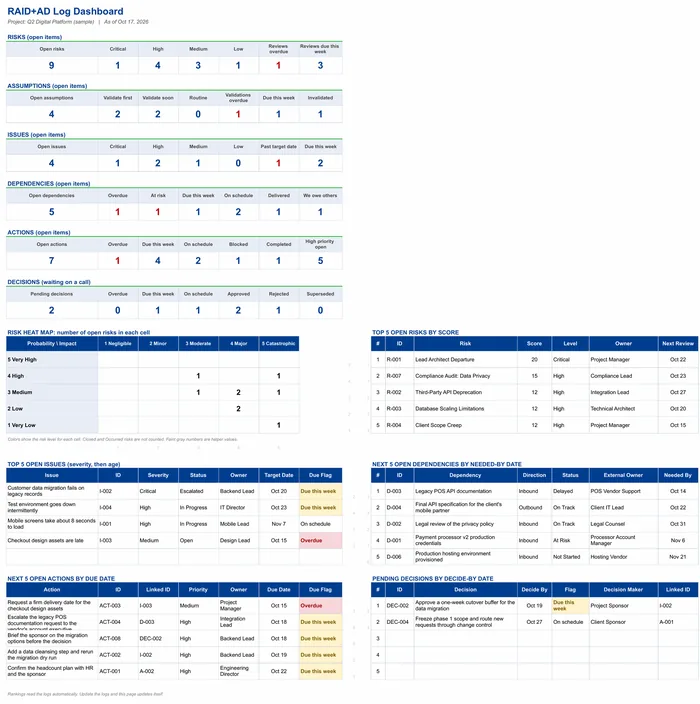
Step up to the RAID Log, and you add assumptions, issues and dependencies, plus a heat map and a dashboard that reads them all.
Choose the RAID plus AD Log, and you get actions and decisions too. Every finding gets an owner and a date, and every decision puts the why on the record.
Pick the one that fits the project you're running. You're the conductor of the orchestra, and you can't conduct what you can't see. I stay ready, so I don't have to get ready, right? Add it to your cart and log your first item today.
A 100-row risk register, mitigation log, live dashboard with heat map, and a settings tab you can tune to your organization.
Risks, Assumptions, Issues and Dependencies, each with its own tab, a dashboard and a Mitigation Log. Two versions: Standard RAID, or RAID + Actions & Decisions.
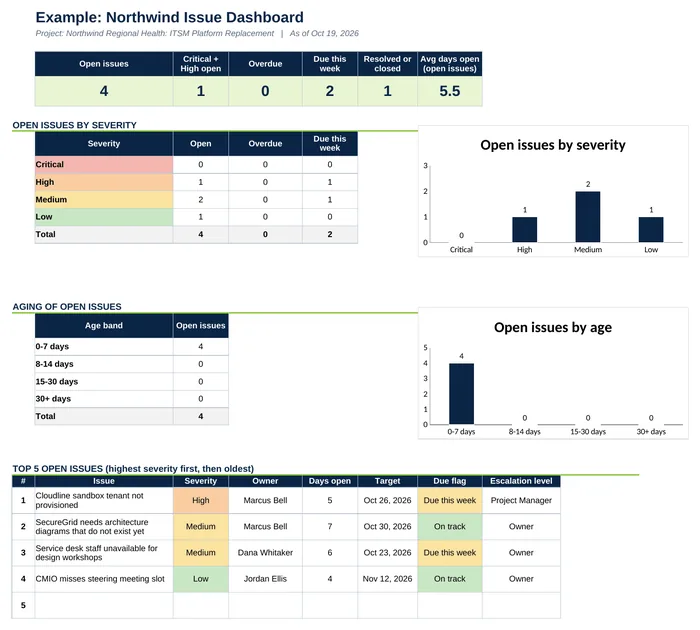
Every issue with an owner, a date and a plan, plus days open, due flags and an escalation matrix.
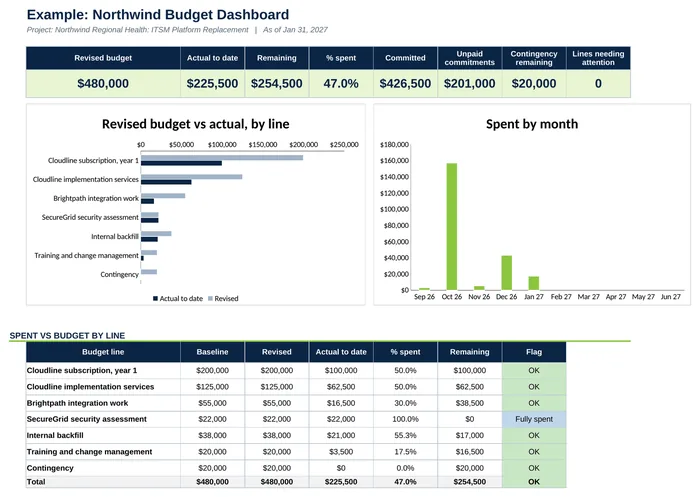
One row per budget line, actuals by month, commitments, flags and a contingency block.
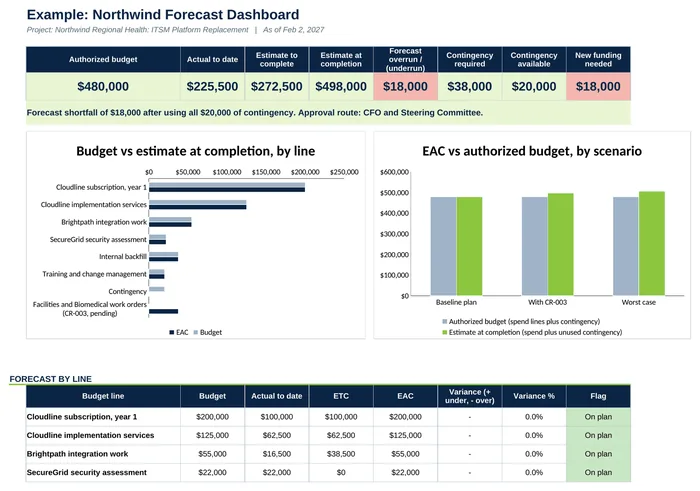
A bottom-up forecast with EAC, a CPI cross-check and plan, change request and worst-case scenarios.
Each vendor scored 1 to 5 on six weighted criteria, rated, trended and flagged for action.
7 templates
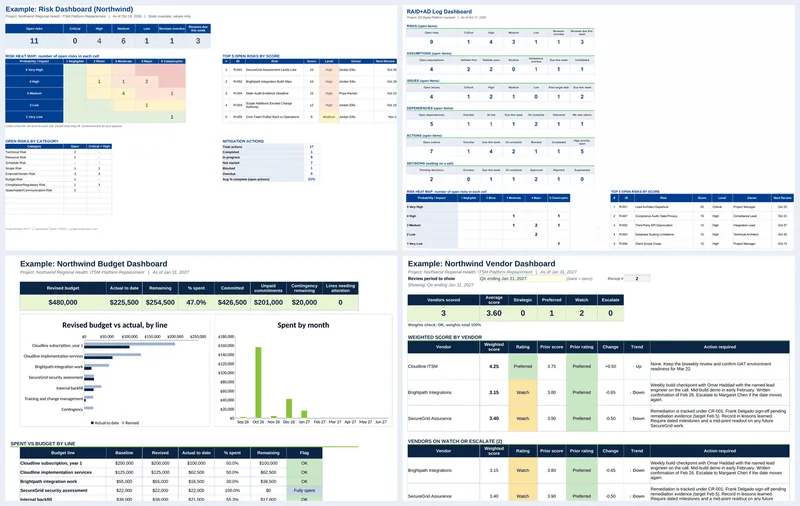
All seven Tracking and Control templates, including both RAID versions.