
Project Charter
$15 Watch the walkthrough2:25
- Word document
- 9 pages
- 12 sections
A project charter is the document that makes a project real. It states why the project exists, what it will deliver, how much it can spend, who decides, and who has signed their name to it. When a stakeholder later asks for something outside the plan, the charter is how you answer without an argument.
Keep it short and specific: a good charter is three to four pages that an executive can read in ten minutes and a team can steer by. Read the complete Northwind example first, a charter for a $480,000 IT service management platform replacement, then fill in the blank template.
- Twelve sections. Purpose and business justification, SMART objectives and success measures, scope in and out, major deliverables, key milestones, summary budget, assumptions, constraints, high-level risks, stakeholders and governance, team and roles, and approval.
- Fillable tables. Each section has its own table, and the gray italic guidance in brackets tells you what to write. Delete it as you go.
- Before you send it checklist. Seven checks, from a purpose that says why now to change authority thresholds agreed with the sponsor and no bracketed text left behind.
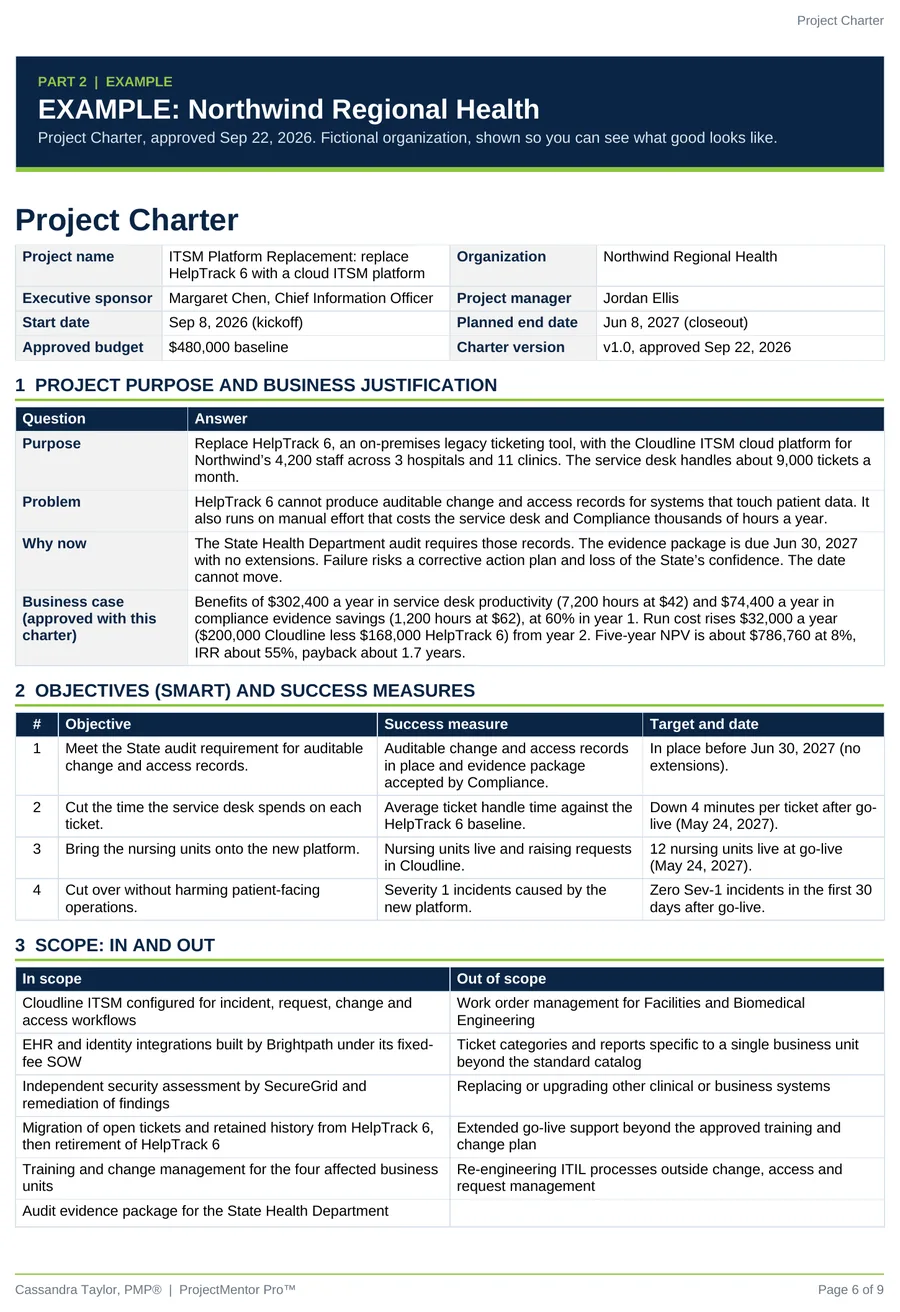
- Finished example. The same twelve sections completed for Northwind, approved Sep 22, 2026.
Also included in Complete Toolkit ($99), Initiation and Planning Pack ($49), Project Kickoff Kit ($35).
Gray bracketed guidance shows what to write in each section. The Northwind example pages can be deleted. Licensed for use by the individual purchaser on their own projects.
See the Project Charter in action
A quick tour of the document, narrated by Cassandra Taylor, PMP: what goes in each section and what the finished example looks like.
Read the transcript
When a stakeholder asks for something that was never in the plan, what do you say? Without a charter, you have an argument. With one, you have an answer.
I'm Cassandra Taylor, and this is the Project Charter. A Word template with twelve sections, plus a finished example, ready to fill in.
A good charter runs three to four pages, and an executive can read it in ten minutes. Purpose, objectives, scope, deliverables, milestones, budget, assumptions, constraints, risks, governance, team, and approval. Gray bracketed text tells you what to write. Delete it as you go.
Start with why now. In the Northwind example, the State audit evidence is due June 30, 2027, with no extensions. That one date explains the budget and the urgency. And the business case backs it with numbers, a five year net present value of about $787,000.
Every objective gets a success measure, a target, and a date. Down four minutes per ticket after go live. Twelve nursing units live. Zero Severity one incidents in the first thirty days. If you cannot check it, it is not an objective.
List what is out as clearly as what is in. Facilities work orders are out. Then agree the change authority before anyone signs. Up to $5,000, the project manager decides. Up to $25,000, the sponsor. Above that, the CFO and the steering committee. So when the ask comes, the answer is already written.
Before you send it for signature, run the checklist. Does the budget total match the baseline? Does every risk have one owner? Is any bracketed text left? Then collect the signatures and file it. Five approvers, one date.
You're the conductor of the orchestra. I stay ready, so I don't have to get ready, right? Add the Project Charter to your cart, and make your project real today.
What's inside
Part 1: blank template
Pages 2 to 5: twelve sections with fillable tables.
Part 2: Northwind example
The same twelve sections, completed, after the blank template.
Quick start
Five steps from reading the example to collecting signatures and sharing the signed copy with the steering committee.