
Closeout Report
$15 Watch the walkthrough2:19
- Word document
- 13 pages
- 13 sections
Closeout is where a project earns its reputation. It is the one document that tells the sponsor what they got for their money, tells the next team what you learned, and tells the auditor that the work was accepted. This one is built to be short, honest and reusable.
It compares what you planned with what happened: objectives, scope, schedule and budget. It records who owns each benefit and when it will be measured, captures lessons learned as a register with an owner for each recommendation, and ends with a sign-off block so the project can be formally closed.
- Thirteen sections. Executive summary, objectives versus results, scope, schedule and budget performance, benefits realization plan, risk and issue recap, vendor performance, change request summary, lessons learned register, handover and support plan, outstanding items, and acceptance and sign-off.
- Lessons learned register. What happened, what worked or did not, and a recommendation written as an action, each with an owner.
- Outstanding items. Everything still open at closeout, each with an owner and a date.
Also included in Complete Toolkit ($99), Communication and Closeout Pack ($29).
Gray bracketed guidance shows what to write in each section. The Northwind example pages can be deleted. Licensed for use by the individual purchaser on their own projects.
See the Closeout Report in action
A quick tour of the document, narrated by Cassandra Taylor, PMP: what goes in each section and what the finished example looks like.
Read the transcript
Most closeout reports are written in a rush and read by no one. But closeout is where a project earns its reputation.
I'm Cassandra Taylor, and this is the Project Closeout Report. A Word template with thirteen sections, plus a finished Northwind example, ready to fill in.
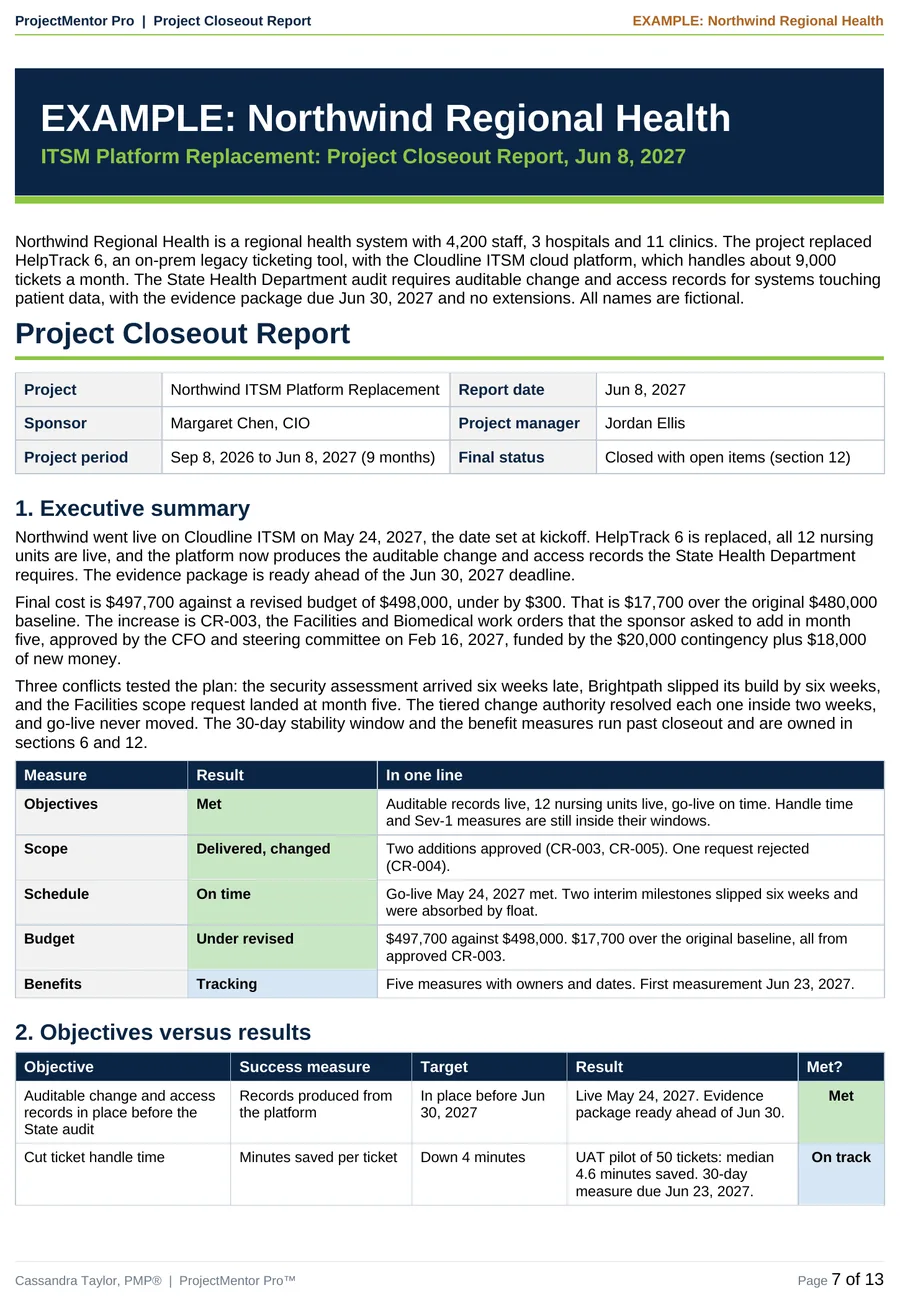
Write the executive summary last, after every table is complete. Five to seven sentences, then a five line scorecard. Objectives met. Scope delivered and changed. Schedule on time. Budget under the revised number. And benefits tracking.
Compare plan with actual, milestone by milestone, and explain every variance over a week. The security assessment landed forty six days late, and the integration build forty two. Float absorbed both, and go live held on May 24.
Then run the arithmetic. Baseline, approved changes, revised budget, final actual, and the variance for every line. Northwind finished at $497,700, $300 under the revised budget, and every dollar over the original baseline traces to one approved change request.
Benefits do not end at go live. For each one, name the measure, the baseline, the target, the owner, and the dates it will be measured. Tom Reilly measures handle time at thirty days, and again at ninety.
Be honest in the lessons learned register. Record what did not work in the same detail as what did, and give every recommendation an owner. List every open item with an owner and a date. If an item has no owner, it is not handed over.
Walk the report with the sponsor first, because nothing in it should be a surprise. Then collect the signatures.
Close the project properly, and leave the next team something to learn from. Add the Project Closeout Report to your cart, and finish every project on the record.
What's inside
Worked example
The Northwind closeout report dated Jun 8, 2027: go-live on May 24, 2027, final cost $497,700 against a revised budget of $498,000.
How to use
Fill the tables from your charter, schedule, budget tracker, change log, RAID log and vendor scorecard, and write the executive summary last.
Pages
How to use and the blank template on pages 1 to 6, the example on pages 7 to 13.